
A Question of When.
Not If.

A Market Divorced From Mood
On Saturday, May 23, 2026, The Wall Street Journal published an article titled “The Stock Market Has Never Been So Good When People Have Felt So Bad,”1 highlighting a growing disconnect between consumer sentiment and stock market performance. The article opens with this observance: “Americans are in a decidedly bad mood. The stock market is decidedly not. This isn’t how it usually works.” In short, consumer sentiment is near historic lows even as share prices reach historic highs.
In fact, the University of Michigan’s Index of Consumer Sentiment — a monthly measure of U.S. consumer confidence dating back to 1952 — fell to its lowest reading ever in May 2026.2 Yet, as The Wall Street Journal noted, that gloom has not been reflected in the performance of broad equity indices.
In recent quarters, we wrote extensively about consistently elevated market valuations. We often cite the cyclically adjusted price-to-earnings ratio (CAPE ratio), developed by economist Robert Shiller. The CAPE ratio divides the current price of the S&P 500 by the inflation-adjusted average of its companies’ earnings over the past 10 years, providing a long-term valuation lens. Today, the CAPE stands at roughly 41.0 — a level seen only once before in nearly 145 years of data tracked by Shiller, during the late-1990s dot-com bubble, just before it burst.3
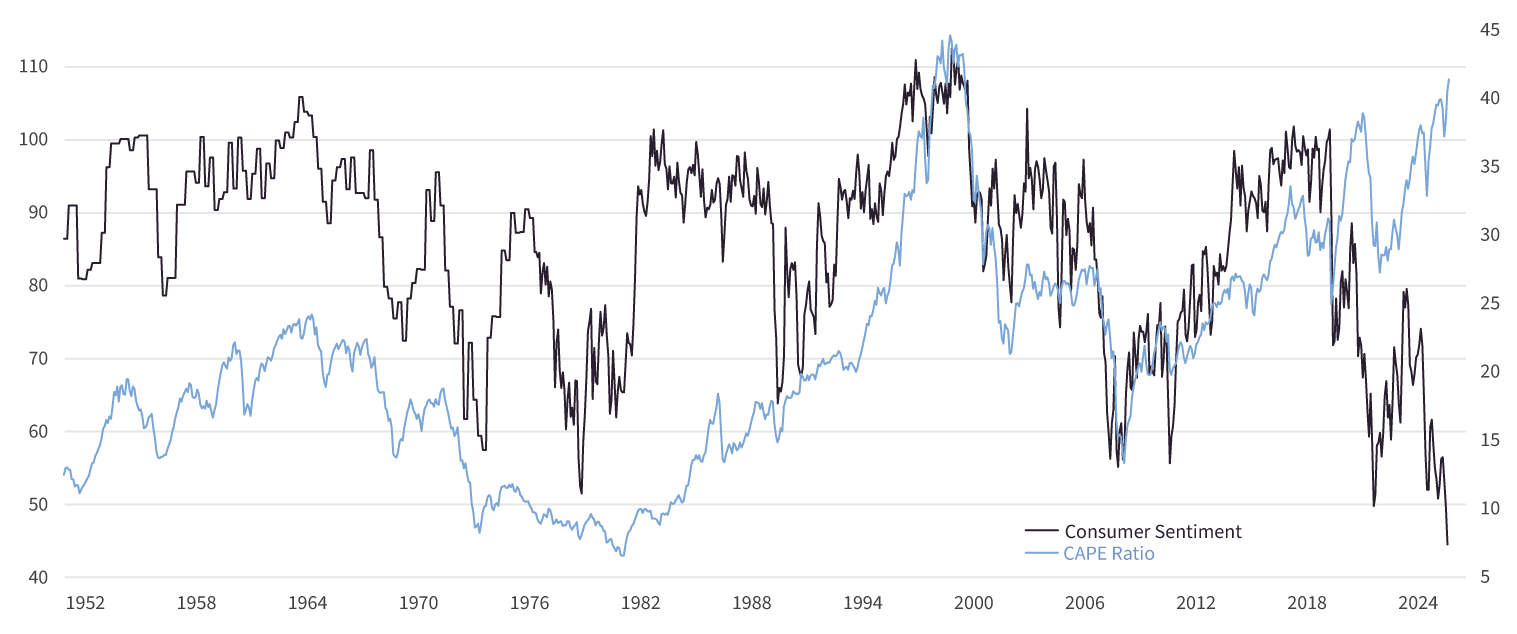
Chart: Consumer Sentiment (Left Axis) compared to CAPE Ratio (Right Axis) as tracked by Shiller.
Our interpretation of these facts, combined with anecdotal signs of euphoric trading behavior, leads us to an unambiguous conclusion: we are currently in a period of unsustainably high broad equity valuations. The operative word is “unsustainably,” implying that, at some point, a reversion to more normal valuation levels — a correction, a reversion to the mean, perhaps even a sudden and dramatic downturn — will occur. History offers ample examples of such episodes: equities plunged during the 2008 Great Financial Crisis (taking years to recover), tumbled in the early months of the COVID-19 pandemic (but recovered within months), and sold off when the U.S. announced sweeping tariffs in April 2025 (only to bounce back within weeks).
We do not know when the next correction will happen, what the precise catalyst will be, how far prices might fall, or how quickly a decline could unfold. But we believe the question is “when,” not “if.” In our assessment, market conditions today have set the stage for a potentially difficult period ahead. And when a broad selloff comes, it will likely overshoot on the downside; what was overpriced can quickly become underpriced as greed turns to fear and indiscriminate selling takes hold.
While we cannot predict timing, our investment process is designed to weather and even capitalize on such market dislocations through three key disciplines:
First, selectivity and deep research. We construct client portfolios with a relatively small number of investments — concentrated positions in businesses we study extensively and know well. We often have direct access to these companies’ senior management, which affords us the opportunity to discuss (and occasionally influence) their strategy and capital allocation. The focused breadth and depth of our research, in our view, provides an information advantage that we expect to translate into superior long-term investment performance.
Second, focus on idiosyncratic value drivers. We seek investment opportunities where the primary drivers of shareholder value are company-specific catalysts or improvements — factors largely within the company’s control — rather than favorable macroeconomic conditions or rising market tides. By favoring situations where outcomes are driven by business-specific progress, we strive to insulate portfolio performance from broad market volatility.
Finally, strict price discipline and patience. We are highly price sensitive. We buy positions only when we can invest at a significant discount to our estimate of intrinsic value, and we exit positions when they approach our appraisal of fair value. In practice, this discipline often results in selling more holdings than we buy when markets become frothy and, conversely, buying more than we sell when markets turn down. If proceeds from selling mature positions cannot be redeployed into attractive new ideas, we prefer to hold cash until better opportunities arise. This patience to await the right entry points is a hallmark of our approach.
Just as critical as preparation is how an investor responds during a market downturn. In a broad selloff, nearly all stocks tend to decline in unison as fear takes hold. Some formerly expensive stocks may finally become fairly valued, fairly valued stocks may become cheap, and already undervalued stocks can get even cheaper. It is natural for anxiety to mount as portfolio values fall. However, we counsel our clients to resist the impulse to sell in panic — such reactions often come at the worst possible time, locking in losses right when assets are “on sale.” In other words, be greedy when others are fearful.4 Maintaining analytical discipline in a crisis is difficult, but essential.
No one can foretell exactly when a downturn will strike. Rather than attempt the impossible task of market timing, we focus on being ready to act when opportunities emerge. We hone our ability to navigate and capitalize on turbulent markets. When the next major dislocation arrives, we are confident in our preparedness and skills to deploy capital prudently on behalf of our clients.
- https://www.wsj.com/economy/consumers/stock-market-consumer-sentiment-af088e87
- https://www.sca.isr.umich.edu/. Accessed on June 11, 2026.
- http://www.econ.yale.edu/~shiller/data.htm. Accessed on June 11, 2026.
- his advice is attributed to Warren Buffett, who in his 1986 letter to shareholders of Berkshire Hathaway, Inc., wrote “What we do know, however, is that occasional outbreaks of those two super-contagious diseases, fear and greed, will forever occur in the investment community. The timing of these epidemics will be unpredictable. And the market aberrations produced by them will be equally unpredictable, both as to duration and degree. Therefore, we never try to anticipate the arrival or departure of either disease. Our goal is more modest: we simply attempt to be fearful when others are greedy and to be greedy only when others are fearful.” Source: https://www.berkshirehathaway.com/letters/1986.html.