
November 19, 2026
Calm. Alert. Opportunistic.
Written By Jeff Geygan, Executive Chairman
Since I began my career in the investment business in 1987, I have experienced the full spectrum of market sentiment: exuberance, downturns, recessions, crises, and periods of extraordinary innovation. Through all these periods, one principle has endured: the price one pays matters.
An extraordinary company can be a poor investment if purchased at the wrong price. Similarly, an underappreciated or misunderstood company can become an excellent investment if purchased at the right price. That distinction sits at the heart of value investing.
The core task of a value investor is to determine what businesses are worth, compare those appraisals with available market prices, and commit capital when the difference provides an adequate margin of safety. The chart below illustrates this concept.
Price Still matters: Value, price, and the margin of safety
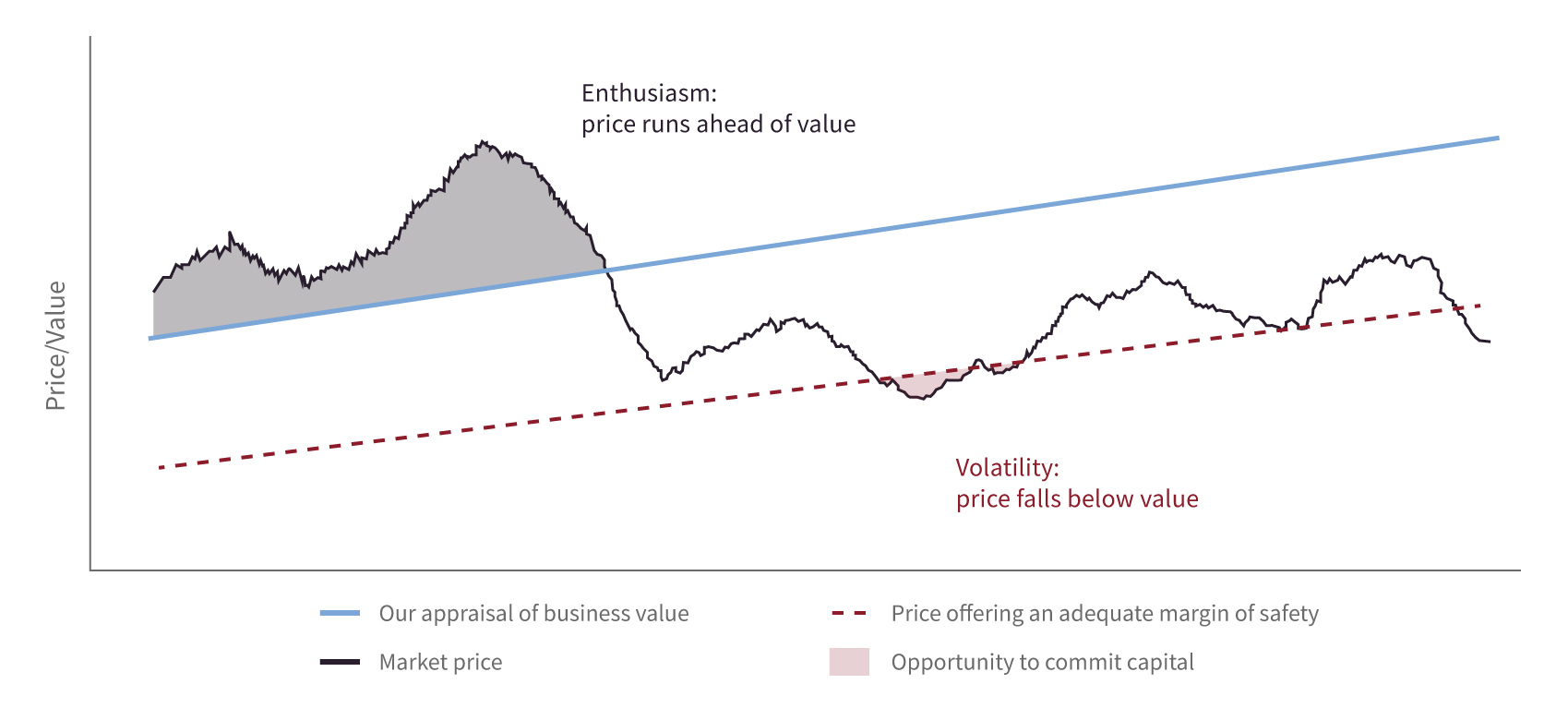
Illustration only. Conceptual depiction, not actual market data or the performance of any security.
When attractive investment opportunities are scarce, as they have been over the past several quarters, I believe investors have but one obvious option. Rather than compromise discipline just to remain fully invested, astute practitioners allowed substantial amounts of cash to accumulate.
This can create discomfort, especially as the prices of available investments continue to rise. But I believe that discomfort must be accepted, and that enthusiasm, however, powerful, does not relieve the obligation to focus on the price paid.
Where we are now
We see the current market environment is highly volatile, with a repricing of risk particularly evident around artificial intelligence and data-center buildouts that has caused downward pricing broadly across the equity markets. While artificial intelligence may ultimately prove to be one of the most consequential technological developments of our time, transformative technology does not eliminate the importance of valuation. Recent repricing has allowed attractive entry points in selected businesses to emerge. For patient investors with available capital, this is creating opportunity.
We evaluate businesses individually, rather than trying to forecast the next market move. We cannot predict if or when the current market weakness will abate, nor do we need to know. Our focus is on the opportunity volatility creates: the chance to acquire businesses we understand at prices that offer an appropriate margin of safety. Our patience and liquidity have positioned us to act.
For much of the recent market advance, remaining disciplined meant accepting the discomfort of holding cash while some investors benefited from being more fully invested, particularly in areas driven by enthusiasm surrounding artificial intelligence. As prices rose, however, we were unwilling to find companies in which to invest that offered the combination of value, financial strength and the margin of safety we require.
There was certainly pressure to do otherwise. As Alan Greenspan once questioned, “How do we know when irrational exuberance has unduly escalated asset values, which then become subject to unexpected and prolonged contractions?” In rising markets, temptation can become a powerful determinant of ill-advised action. We resisted that temptation.
How do we know when irrational exuberance has unduly escalated asset values, which then become subject to unexpected and prolonged contractions...?
— Alan Greenspan, Federal Reserve Chairman, December 5, 1996
In our third-quarter client letter, we described our posture as calm, alert and opportunistic. The recent increase in variability across market prices is beginning to demonstrate why that discipline matters, and the cash we accumulated has quickly become purchasing power.
Our Process: Calm. Alert. OpPortunistic
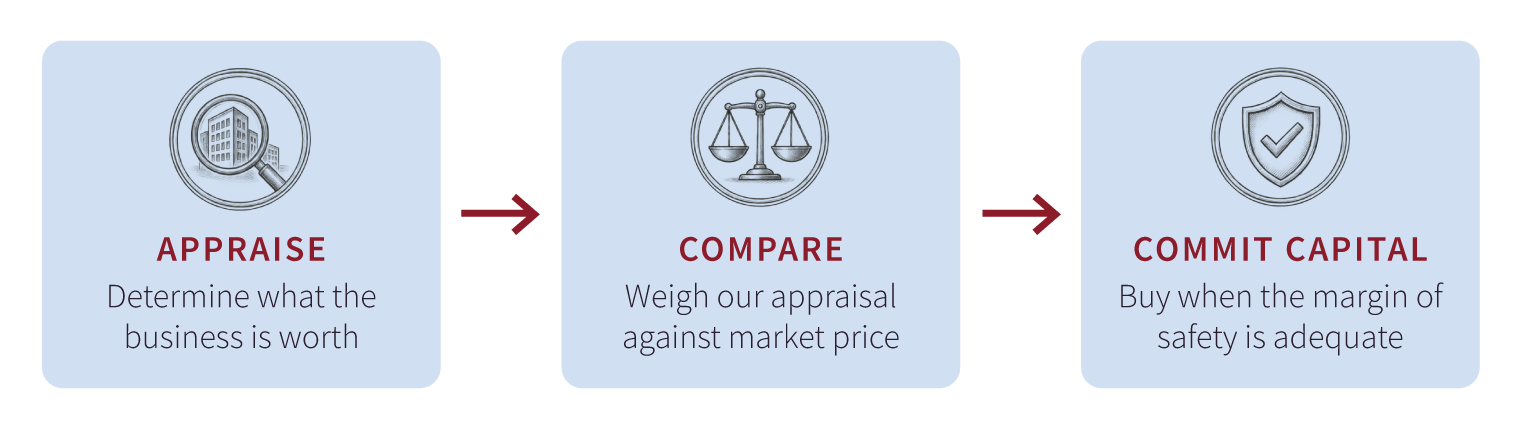
Cash is purchasing power: the flexibility to act without selling another investment first
We are not waiting for an all-clear signal. As individual opportunities meet our standards, we are selectively putting capital to work.
Concluding thoughts
This July, after a twenty-five-month stint as the CEO of Rocky Mountain Chocolate Factory, Inc., one of GVIC’s portfolio companies, I returned to GVIC full time. I have no doubt that the experience I gained as a public company CEO will be invaluable to GVIC as our collective analytical discipline evolves. Having sat on the other side of the table in dozens of investor meetings, I now bring a fresh perspective to our research analysis. My insights into corporate leadership and governance dynamics provide a viewpoint that few investment managers enjoy, which I expect to inform our future interactions with senior management and sharpen our ability to gain valuable insights into the companies to which we commit capital. I am glad to be back in action with the team.
With volatility as the backdrop, opportunity is our focus. We believe the repricing of risk is creating more interesting entry points, and we have the liquidity, research preparation, and discipline to respond.
About the Author

Jeffrey R. Geygan founded GVIC in 2007 and serves as Executive Chairman, having served as CEO through May 2024. Investing since 1987, he brings nearly four decades of experience, has served as a public-company CEO and has chaired three public-company boards. He currently serves on the boards of Rocky Mountain Chocolate Factory (RMCF) and Loop Industries (LOOP) and previously served on the board of Climb Global Solutions (CLMB). His perspective as investor, CEO and director informs his focus on capital allocation, governance and strategy. He holds a B.A. in Economics from the University of Wisconsin–Madison.